
From music playlists to social media feeds, artificial intelligence has quietly become part of our daily lives. Now, AI in education is taking center stage, and it’s changing everything.
I’ve explored different industries over the years – film, investment, and real estate – but I’ve always come back to PK-12 education and edtech. That’s my focus. And right now, nothing is reshaping it more than AI.
The Shift: AI in K-12 Education
Reactions to AI in K-12 education have been mixed. Many publishing industry folks, especially those who’ve been around since the printed textbook era, are or have been moving through the five stages of grief: denial, anger, bargaining, depression, and acceptance.
I equate the depression phase to the “all is lost” moment in storytelling. If you’ve read Save the Cat, one of the most read screenwriting books of all time, you know it. It’s that point two-thirds into a film where everything feels beyond repair. The main character is stuck, defeated, out of options. Many publishers are at that moment now.
But like any good story, it doesn’t end there.
The Opportunity: Generative AI in Education
I’ve chosen to lean in because the problems AI can solve in education are ones teachers have been struggling with for decades: too many students, too little time, content that fits no one perfectly because it’s trying to fit everyone.
The real opportunity isn’t chatbots answering homework questions but tools that support creating materials that didn’t exist five minutes ago, built around what a specific kid actually needs today.
The Problem Most Tools Aren’t Solving
Walk into any classroom, and you’ll find a 4th grader reading at a 2nd grade level sitting next to one reading at a 7th grade level. The teacher has 28 students, one prep period, and a district-mandated curriculum that wasn’t designed with either of those kids in mind.
Most AI tools hand teachers a faster search engine. That’s not the gap.
The real gap is simple: teachers don’t have enough of the right content. Leveled reading series cost a lot and don’t offer many options. And expecting a teacher to create different materials for every student, every single day, isn’t realistic.
This is where Pickatale Create stands out from the noise.
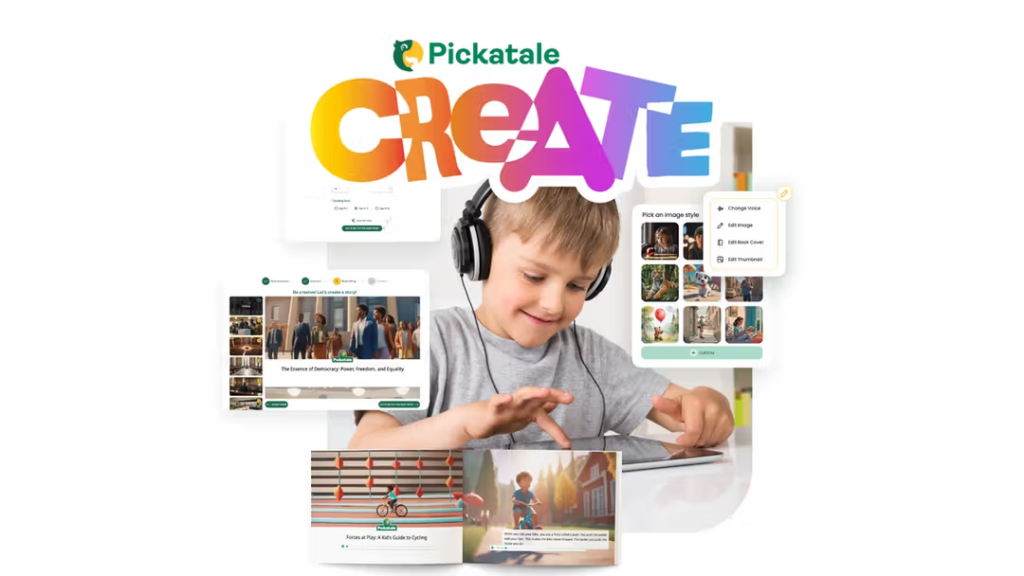
It’s an AI-powered story creation tool built specifically for K-8 classrooms. In minutes, a teacher can generate a fiction or nonfiction story tailored to a student’s reading level, language, age, interests, and curriculum objectives. The stories come with illustrations, audio narration, and read-along features. They’re built for children, quality-assured, and designed by people who understand what learning actually looks like.
A struggling reader gets a story that meets them where they are without feeling like a “baby book.” An advanced reader gets a challenge. An ELL student gets content in their language. A teacher covering a unit on ecosystems can have a custom nonfiction text ready before the lesson starts.
That’s a structural change in what’s possible inside a classroom.
The Future of AI in Education
The tools that will actually matter aren’t the ones with the longest feature list. They’re the ones that reduce friction, respect teachers’ expertise, and make students feel like the curriculum was made for them — because it was.
AI in K-12 education isn’t a question of if anymore. The question is whether the tools we adopt will be built to serve learners or just to sell subscriptions. The difference shows up in a child’s face when they open a book that finally feels like it was written for them. That’s worth getting right!
Read my previous blog where I wrote about supporting reluctant readers to help children discover the joy of reading.